Lab Meeting May 2026
The Data Donation Lab is hosting its next online Lab Meeting on 7 May from 12:00 to 13:00 (Zurich Time). The session will feature two invited talks and updates on current Lab activities.
Gues Lectures
Zoltán Kmetty
Eötvös Loránd University
Tackling Friction in Data Donation Workflows: An Experimental AI Intervention to Mitigate the Willingness-to-Donation Gap
Authors: Zoltán Kmetty, Ádám Stefkovics, Árpád Knap
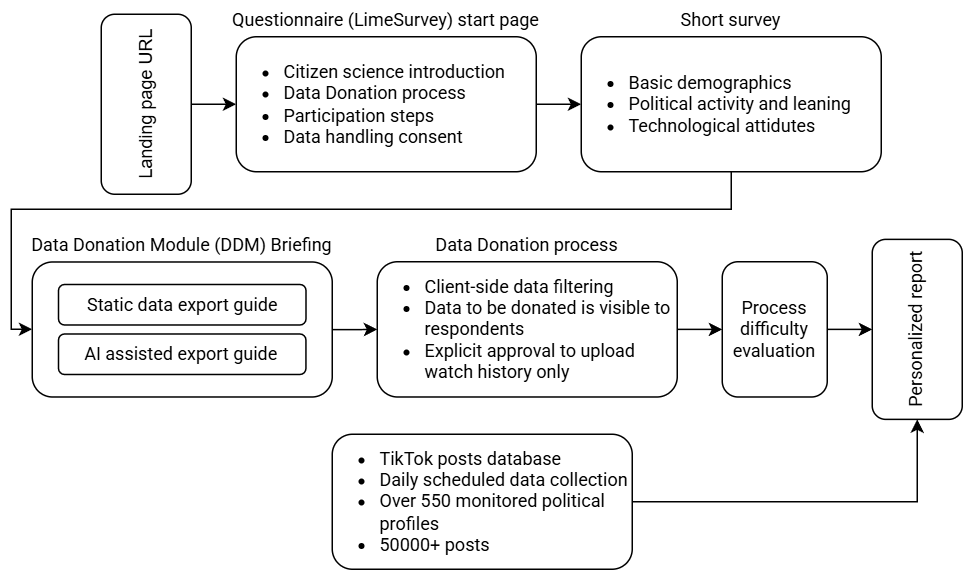
TikTok’s algorithms deepen political polarization by creating closed communication spaces. This research investigates political consumption in Hungary during the 2026 elections using a citizen science data donation approach, building on the work of Wedel et al. (2026). Participation is incentivized by a personalized “digital mirror” that compares individual habits to national trends.
The presentation details the technical pipeline and a preregistered experiment addressing high drop-out rates in data donation. We employ a split-ballot design comparing AI chatbot-assisted support with text-only instructions, hypothesizing that AI reduces perceived burden and increases donation rates.
I present preliminary results on how technology affinity and AI attitudes moderate the effectiveness of the chatbot. These findings clarify how AI-driven tools can effectively support complex data collection protocols and enhance participant retention in digital trace research.
Nico Pfiffner
University of Zurich
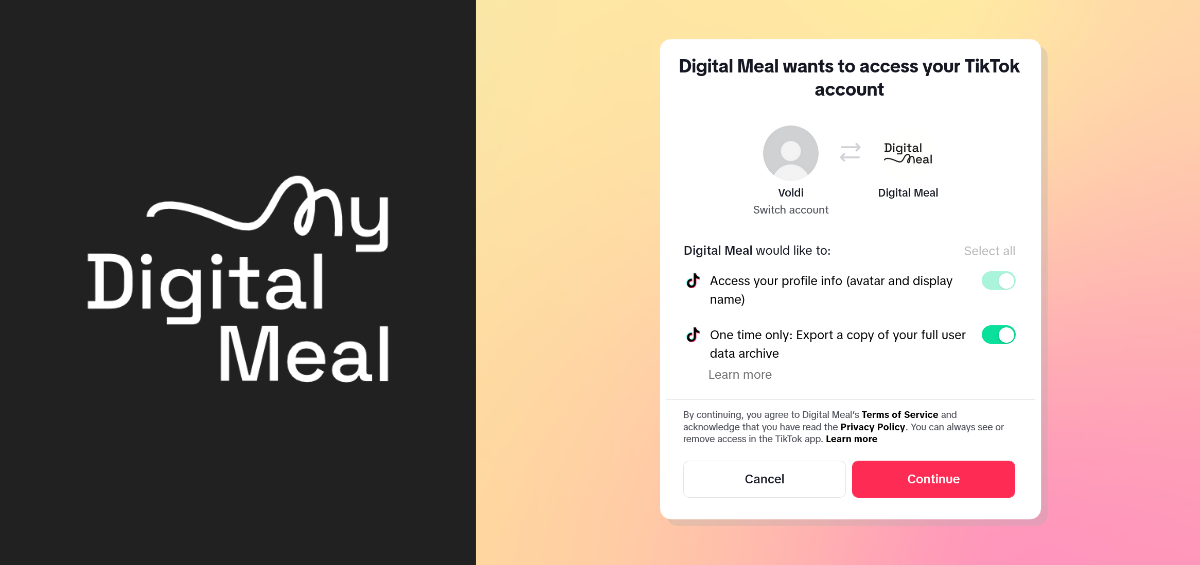
My Digital Meal – Using TikTok’s Portability API to collect data donations
Authors: Nico Pfiffner & Thomas Friemel
We present My Digital Meal, an initiative that involves adolescents and young adults in the collection of TikTok data donations to better understand how TikTok is used and how usage patterns evolve over time.
My Digital Meal leverages TikTok’s Portability API to facilitate the data donation. This portability approach allows participants to grant researchers direct access to their data through TikTok's API, removing the need for participants to manually facilitate the data transfer. This signifies a great advantage over the commonly used download-upload approach, in which participants have to manually download their data takeout and then re-upload it to a data donation collection tool.
We demonstrate the implementation of the portability approach and compare it with the conventional download-upload approach.